

Postgraduate
School of Artificial Intelligence Holds 2025 National Natural Science Fund Project Application Expert Review Meeting
To promote the implementation of the "Vanguard Plan" Sci-Tech Climbing Initiative and further enhance the college's approval rate for National Natural Science Foundation (NSFC) projects, the School of Artificial Intelligence held the 2025 NSFC Expert Review Meeting on February 22, 2025, in the Hexi Second Conference Room. The meeting invited Professor Xiong Deyi from Tianjin University, Professor Gao Zan from Tianjin University of Technology, and Professor Liu Zheli from Nankai University to provide guidance. It was chaired by Dean Zhang Xiankun, with Vice Dean Zhao Tingting and faculty members applying for the 2025 NSFC projects in attendance.
The three professors, renowned for their outstanding achievements in natural language processing, computer vision, and cyberspace security, brought professional expertise to the event. In his opening remarks, Dean Zhang Xiankun expressed a warm welcome and sincere gratitude to the experts. He emphasized the significance of NSFC projects for enhancing the college's scientific research capabilities and encouraged faculty members to seize this opportunity to refine their application materials.
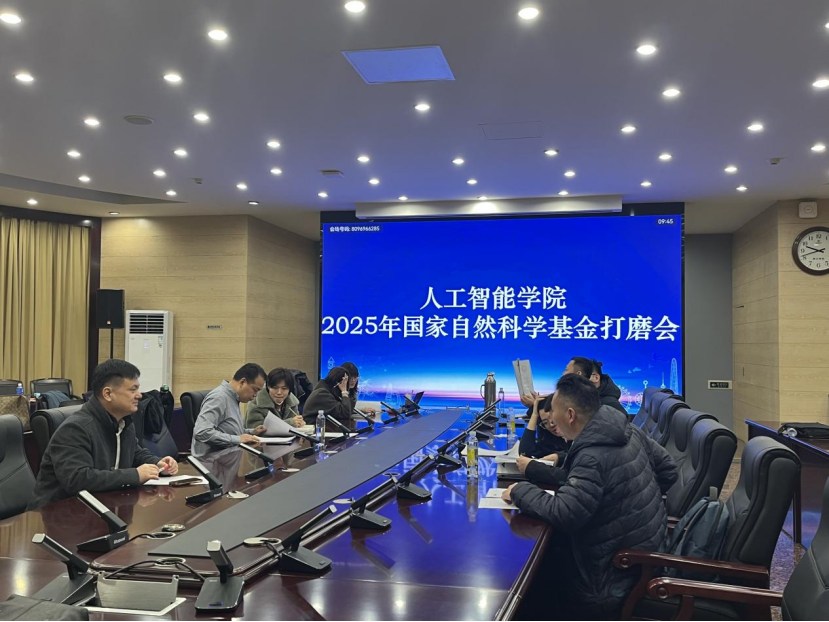
Amid a warm and engaging atmosphere, the review session officially commenced. The faculty members took turns presenting their proposals, elaborating on their research ideas, methodologies, and expected outcomes. The experts listened attentively and noted key points. Professor Xiong Deyi pointed out that some projects lacked clear research objectives and in-depth justification, merely listing references without delving into critical scientific issues. For instance, a proposal on natural language processing applications in healthcare failed to thoroughly explore key scientific challenges. Professor Gao Zan observed that certain proposals attempted to cover too much content without a clear focus, and the research methods were not well-suited to the problems addressed. For example, a computer vision object detection project applied classical algorithms with inherent limitations but proposed no improvements. Professor Liu Zheli emphasized that some proposals lacked innovation and feasibility analysis. Citing an example of an AI security proposal, he noted that the research plan might face constraints due to data privacy regulations but offered no countermeasures.
The event concluded successfully, with faculty members gaining valuable insights into proposal writing and research design, significantly enhancing the quality and competitiveness of their submissions. In his closing remarks, Dean Zhang Xiankun encouraged the faculty to carefully review the experts' suggestions, refine their proposals, and strive for outstanding results. The school will continue to strengthen the organization and support of scientific research, providing more opportunities for academic exchange.
Moving forward, the School of Artificial Intelligence at Tianjin University of Science and Technology will use this event as a catalyst to enhance research team building, optimize the management of fund applications, and encourage faculty to explore cutting-edge and innovative research. By doing so, the school aims to achieve greater breakthroughs in National Natural Science Fund applications and scientific research, thereby advancing disciplinary development and social progress.
Writer: Tserin Lhamo
Photographer: Tserin Lhamo
Reviewers: Zhou Yixuan, Li Bingbing, Qi Mengtong